How to Use a Whistle and Hand Signals With Other Kayakers
Conversation disappears quickly when wind, waves, or distance separate a kayak group. I’ll help you establish simple whistle and hand-signal agreements for stopping, danger, regrouping, and assistance before you need them.
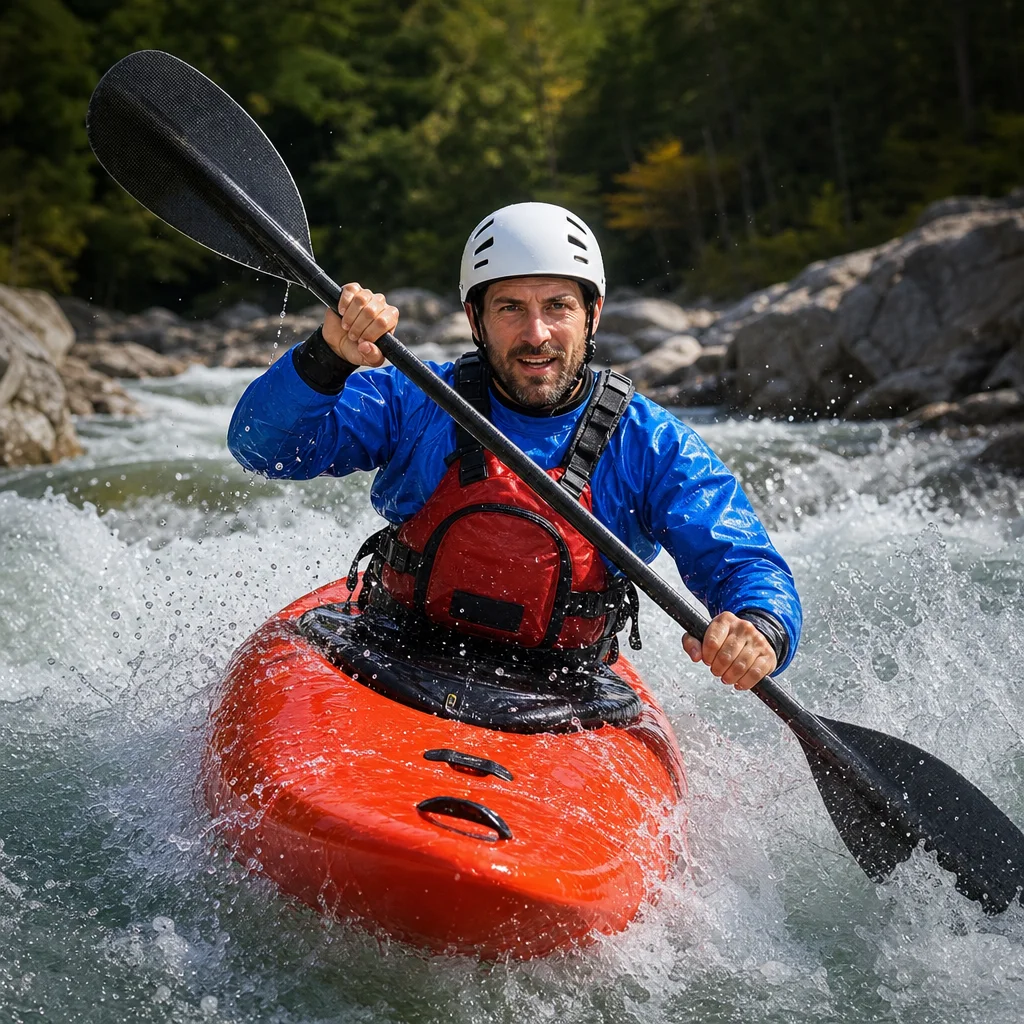
Wind, waves, boat traffic, and distance can make shouted instructions unreliable surprisingly quickly. A group that agrees on a few simple signals before launching can respond more calmly when someone needs to stop, points out danger, or falls behind.
Whistles and hand signals work best as a shared system, not as a collection of universal gestures. The important trade-off is straightforward: hand signals communicate more detail when everyone can see them, while whistles attract attention when visibility or noise becomes a problem. Neither method replaces good spacing, a clear plan, and the ability to stop and help one another.
Agree on the signal system before launching
Take a few minutes on shore or at the put-in to review the signals your group will use. Keep the system short enough that everyone can remember it under stress.
At minimum, agree on signals for:
- Stop or hold position
- Danger or hazard
- Regroup
- Assistance needed
- Emergency
- “I’m okay” or “I understand,” if your group finds it useful
Also decide who will lead, who will paddle sweep at the rear, and how the group will confirm that a signal has been received. A signal without confirmation can be mistaken for a random movement or missed entirely.
Confirm your group’s code: Before launching, ask each paddler to repeat or demonstrate the agreed whistle patterns and hand signals. Local clubs, guides, and organized trips may use different conventions, so use the system your group has explicitly adopted rather than assuming a gesture is universal.
A simple confirmation might be a raised hand, a nod, or repeating the signal back. For a larger group, the leader can send a message down the line: the nearest paddler acknowledges it, then the next paddler does the same. This takes longer than shouting but is more dependable when the group is spread out.
When to use a whistle
Carry a whistle where you can reach it while seated and wearing your normal paddling clothing. A whistle attached inside a dry bag or buried in a deck compartment may be well protected, but it won’t help much when you need immediate attention.
Use the whistle to gain attention, communicate over distance, or supplement a visible hand signal. Blow it deliberately rather than continuously. Long, frantic blasts can make it harder for others to understand what you want.
Many paddling groups use a short blast for attention and three blasts as an emergency signal. These patterns are common in outdoor and maritime settings, but they aren’t interpreted identically everywhere. Your group should agree on the meaning before getting on the water.
A practical system might look like this:
- One short blast: Look toward me or pay attention.
- Two short blasts: A prearranged nonemergency message, such as regroup or check in.
- Three blasts: Emergency or immediate assistance needed.
- A longer blast: Stop, if your group has selected that meaning.
The exact pattern matters less than consistency. Avoid creating several similar signals that are difficult to distinguish in wind or panic. If your group uses only one attention signal and one emergency signal, everyone has fewer details to remember.
A whistle isn't a substitute for calling emergency services or using a communication device when outside help is needed. Depending on your location and trip, a phone, marine radio, personal locator beacon, or satellite communicator may be appropriate. Learn how those devices work before the trip, and keep them protected from water while still accessible.
Hand signals for visible communication
Hand signals are useful when the group is close enough to see one another and conditions are calm enough to interpret movements. Hold the gesture high and keep it clear. If you’re paddling, stop or slow down before signaling so your hands and body are easier to see.
Stop or hold position
Choose one obvious gesture, such as raising a hand vertically or holding the paddle in a clearly agreed position. The specific gesture should be reviewed with the group because paddling communities don’t all use the same visual code.
When you see the stop signal, stop paddling and maintain a stable position if it’s safe to do so. Don’t automatically drift into another kayak. In moving water, wind, or current, stopping may require edging, ferrying, or moving toward a safer area instead of simply letting the boat drift.
The person who gave the signal should look for confirmation. If the group is spread out, pass the signal along rather than assuming the last paddler saw it.
Danger or hazard
Point clearly toward the hazard, then use the agreed danger gesture. A pointed finger alone can be ambiguous: you may be indicating a landmark, a route, or another paddler.
After pointing, give the group a useful direction if one has been agreed upon. For example, you might point toward a rock and then point to the safer side. Don’t rely on a dramatic gesture to communicate a complicated maneuver. In limited visibility, add a whistle and move to a position where the group can see you.
Possible hazards include:
- Rocks, strainers, or shallow obstructions
- Breaking waves or strong current
- Motorized traffic
- A swimmer or loose equipment in the water
- A rapidly changing weather or water condition
Make the signal early. A warning given while everyone still has room to maneuver is much more useful than one given when the hazard is already beside the group.
Regroup
Use an agreed gesture that tells paddlers to gather at a particular safe location, not merely to stop wherever they are. Point toward the meeting place and identify it with a clear landmark if possible.
A regroup point might be the downwind side of a broad shore, a protected eddy, or a visible beach. Avoid choosing a location that puts paddlers in the path of traffic, current, breaking waves, or falling rocks.
Once there, count the group and check whether anyone is missing, tired, injured, or separated from equipment. A regroup is also a good time to adjust spacing and repeat the next section’s hazards.
Assistance needed
An assistance signal should be distinct from an emergency signal. Use it for situations such as a tired paddler needing a tow, a loose spray skirt, a paddle problem, or uncertainty about the route. If there’s an immediate threat to life or a capsize that the paddler can’t manage, use the emergency signal instead.
Point to yourself, then use the agreed assistance gesture. If you need a specific item or action, explain it when the group is close enough to hear. A hand signal should attract the right help; it shouldn’t force others to guess what you need.
Match the signal to the conditions
The best communication method changes with the environment.
Use hand signals when:
- The group is within clear sight
- The sun isn't directly obscuring the gesture
- Paddlers can maintain a safe position while looking at one another
- The message is simple and the receiver can confirm it
Use a whistle when:
- Wind, waves, or distance make speech unreliable
- A paddler’s back is turned
- Visibility is reduced but sound can carry
- You need to attract attention quickly
Use both when:
- The situation is urgent
- Some paddlers may not have seen the gesture
- The group is spread out
- A hazard requires both attention and directional information
Don’t keep staring at the person signaling while drifting into danger. First control your kayak, then look for the message, then respond. In current or surf, a safe position takes priority over perfect communication.
Avoid signals that create confusion
A few common mistakes make group signals less useful:
- Changing meanings during the trip: A signal for regroup shouldn't become a signal for stop halfway through the outing.
- Using casual gestures as instructions: Waving, pointing, and raising a paddle can mean different things to different paddlers.
- Overloading the system: Too many codes are hard to remember, especially for beginners.
- Failing to confirm: The sender may believe everyone received the message when only the nearest paddler saw it.
- Signaling too late: Warnings and regroup instructions need time and space.
- Whistling without a plan: Repeated blasts may attract attention but still leave others unsure what action to take.
- Ignoring the rear paddler: The leader may see an obstacle while the sweep paddler sees someone falling behind. Both ends of the group need a way to communicate.
Practice the signals in calm water before relying on them in wind, current, fog, or surf. Try them while wearing gloves, holding a paddle, and facing different directions. The goal isn’t to perform a formal drill; it’s to discover which gestures remain recognizable when normal conversation breaks down.
A simple prelaunch checklist
Before you leave, make sure everyone knows:
- Who leads and who sweeps the group.
- Which signal means stop.
- Which signal identifies danger.
- Where and how to regroup.
- Which whistle pattern means emergency.
- How to request ordinary assistance.
- How paddlers confirm that they received a message.
- What communication device or outside-help plan applies to the trip.
Keep the system simple, use the same meanings consistently, and signal earlier than feels necessary. With those habits in place, a whistle can cut through noise, a hand gesture can clarify direction, and the group can make decisions without depending on shouted conversation.