What a Kayak PFD Should Fit Like While You Paddle
I’ll show you how a kayak PFD should fit, how to adjust it without restricting your stroke, and how to avoid choosing a loose or poorly labeled device that can shift when you need it most.
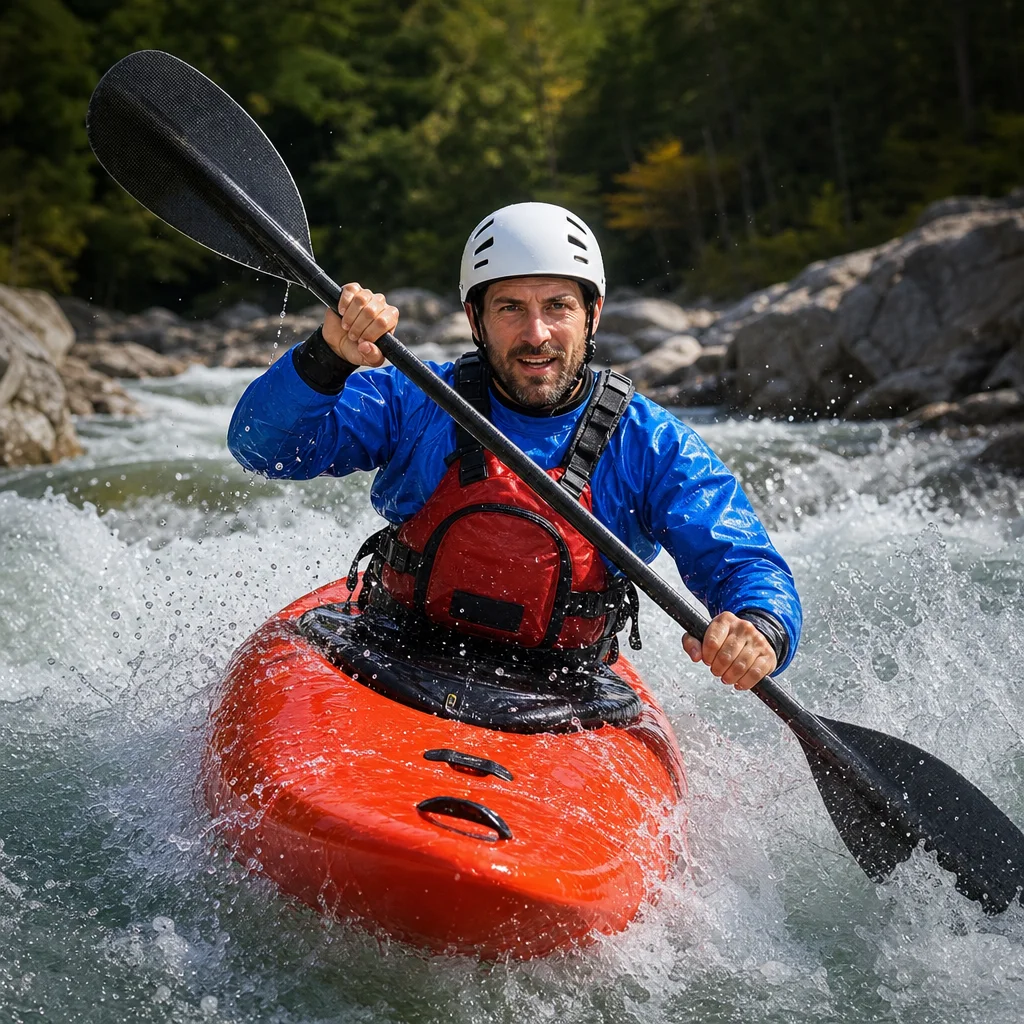
By Kyle Bennett · Kayak Gear
The right fit is snug, stable, and easy to move in
A kayak PFD should feel close to your body without making it difficult to breathe, rotate, or paddle. The most common mistake is choosing one that feels comfortable while standing but rides up when you sit, lean, or enter the water.
For beginners and families, the goal isn't simply to find the most buoyant-looking vest. You need a device that is approved for the place and activity, fits the wearer correctly, stays in position, and allows a full paddling motion.
A good fit should meet four tests:
- It sits low and securely on your torso.
- It doesn't ride up over your face or chin.
- The arm openings allow unrestricted paddle strokes.
- The closures stay tight without painful pressure or large gaps.
Start with the correct size
Use the manufacturer’s sizing chart rather than guessing from a shirt size. Adult paddling PFDs are commonly sized by chest measurement, while child and youth models may also use weight ranges. Measure around the fullest part of the chest, then compare that measurement with the specific model’s chart.
Don't put a child in an adult PFD simply because the adult model is available. A child’s device needs to match the child’s size and weight range, and it should be tested on the child before the outing. Oversized arm openings or a vest that floats up toward the face are signs that the fit isn't suitable.
Likewise, a larger adult shouldn't assume that tightening every strap will make a small PFD safe. If the panels can't lie flat or the buckles are near the end of their adjustment range, choose a different size or model.
Check the approval label: Before buying or paddling, confirm that the PFD is approved for the activity and jurisdiction where you’ll use it. In the United States, look for the appropriate U.S. Coast Guard approval information; in Canada, check the Transport Canada approval and labeling requirements. Local rules, age requirements, and accepted device types can vary, so verify them with the relevant boating authority.
Adjust the PFD while sitting in your kayak
A PFD that fits while standing may behave differently once you sit in a kayak. Your torso bends, the seat presses against the lower panel, and the arm openings need to clear your paddle stroke. Make the final adjustment in the position you’ll actually use.
Follow this sequence:
- Loosen the straps before putting the PFD on. This gives the panels room to settle instead of forcing them into place.
- Zip or buckle every closure. A partially closed vest can't be adjusted accurately.
- Sit in your kayak or a similar seated position. Keep your back reasonably upright and place your hands as if you were holding a paddle.
- Tighten from the lower straps upward. Secure the vest around your torso first, then adjust the upper straps so the shoulders stay in place.
- Check both sides. The front and back panels should sit evenly rather than twisting around your body.
Strap systems differ by design. Some PFDs use multiple side straps, while others use a combination of chest, shoulder, and waist adjustments. Follow the product instructions, but the general result should be the same: a close, even fit that doesn't shift when you move.
Use the lift test to check for ride-up
The lift test is a simple way to identify a PFD that is too loose or too large.
Put the PFD on correctly and tighten all closures. Have another person stand behind you and gently pull upward on the top of the shoulder areas. They should use steady, moderate pressure rather than yanking.
The PFD should stay in place with little movement. If it slides toward your chin, covers your face, or leaves the torso noticeably exposed, tighten the straps and repeat the test. If it still rises, the device may be the wrong size or shape for you.
Don't solve severe ride-up by tightening the vest until it becomes painful. A PFD that restricts breathing or causes pressure points will be difficult to wear consistently, and it may still be poorly matched to your body.
For a child, lift gently and watch the position of the arm openings and head. A properly fitted child’s PFD shouldn't ride over the child’s face. Follow the manufacturer’s instructions for the model, and supervise children whenever they are near or on the water.
Make sure your arms and shoulders can work
Kayaking requires repeated shoulder rotation, elbow movement, and torso rotation. A PFD can be secure but still be a poor paddling fit if it interferes with these movements.
With the PFD adjusted, perform a few slow practice strokes. Reach forward, pull your hands toward your hip, and rotate your torso in both directions. Raise your arms as if preparing for a recovery or bracing movement. The arm openings shouldn't cut into your armpits, and the shoulder panels shouldn't pull tightly against your neck.
Pay attention to these warning signs:
- You can't reach forward without the vest pressing into your neck.
- The lower edge catches against the kayak seat or sprayskirt tunnel.
- The arm openings rub your skin during normal strokes.
- The front panels press into your chest when you lean forward.
- The vest shifts from side to side as you rotate.
Some paddlers prefer a higher-cut or thinner-front PFD because it provides more room to bend and rotate. Others prefer broader foam coverage and a simpler recreational design. Neither approach is automatically best. The trade-off is usually between freedom of movement and the amount, shape, and placement of foam around your torso.
Understand buoyancy labels without relying on appearance
A bulky PFD isn't necessarily the right PFD for you, and a slim paddling vest isn't automatically inadequate. Buoyancy, approval, intended use, wearer size, and fit all matter.
Read the label and product information for:
- The approval mark and approving authority.
- The intended activity or use category.
- The device’s buoyancy or performance information.
- The recommended chest, waist, or weight range.
- Any limitations, maintenance requirements, or warnings.
In the United States, newer labels may use performance-level information rather than relying only on older Type designations. Older terminology can still appear in product descriptions and discussions, so read the actual approval label instead of assuming that a familiar term tells you everything about the device.
In Canada, product labels and approvals may distinguish between personal flotation devices and lifejackets, with different design and performance requirements. Don't assume that a PFD purchased in one country automatically satisfies every rule in the other.
More buoyancy isn't a substitute for a secure fit or proper use. It can also affect bulk, comfort, and mobility. For ordinary recreational kayaking, choose an approved device appropriate to your activity and body size, then make sure you will actually wear it correctly.
Compare common PFD designs for kayaking
Recreational vest
A basic recreational PFD is often straightforward to put on and adjust. It may work well for relaxed paddling, family outings, and boats with plenty of room around the torso.
The trade-off is that broad foam panels can feel warmer or restrict torso movement in a snug cockpit. Check the arm openings and lower edge while seated before deciding.
Paddling-specific vest
A kayaking or paddling-specific PFD usually has larger arm openings, a shorter or shaped torso, and adjustments designed for repeated strokes. Some include pockets or attachment points for small essentials.
These features can improve mobility, but they don't guarantee a good fit. Pocket placement, shoulder shape, and torso length still vary. A specialized vest that rides up is worse than a simpler vest that remains secure and comfortable.
Inflatable design
Inflatable devices can be less bulky, but they may have restrictions related to activity, wearer age, swimming ability, water conditions, and required activation or maintenance. They also may not be appropriate for every kayaking situation, especially where immediate flotation or frequent immersion is possible.
Read the approval label and manufacturer instructions carefully before considering one. For many beginners and families, an inherently buoyant foam PFD is the simpler option because it provides flotation without depending on manual or automatic inflation.
Check the fit each time you paddle
PFD fit can change when you add a clothing layer, adjust a kayak seat, or switch from one boat to another. Make a brief check part of your launch routine:
- The PFD is fastened according to its instructions.
- The straps are snug and not dangling where they can catch.
- The vest sits in the same position on both sides.
- You can breathe comfortably and rotate your torso.
- The arm openings don't rub or restrict your stroke.
- The device isn't damaged, waterlogged, excessively compressed, or missing hardware.
Avoid placing heavy clothing underneath a PFD if it prevents the vest from fitting securely. In cold conditions, choose layers and a PFD combination that still allows the closures to tighten properly. Test the complete setup before leaving shore.
Don't modify a PFD by cutting foam, removing straps, drilling holes, or adding hardware that the manufacturer didn't approve. Repairs and replacement decisions should follow the product instructions. If the flotation material is damaged or the device no longer fits the wearer, replace it rather than trying to make it work.
A simple decision checklist
Before buying or using a kayak PFD, ask:
- Is it approved for my location and intended activity?
- Does its size match my chest or weight measurement?
- Does it stay down during a gentle lift test?
- Can I paddle, rotate, and reach without restriction?
- Will it fit over the clothing I plan to wear?
- Can I fasten and adjust it correctly every time?
- Is it in good condition and suited to the paddler’s experience and age?
Try the PFD in a seated paddling position whenever possible. The best choice is the one that combines the required approval and buoyancy with a stable fit you can wear comfortably for the entire outing. Once you find that fit, keep the adjustment settings consistent and check them before every launch.