How to Decide Whether a River Is Too High for Your Kayak
A river can be high without being fast, or fast without showing an alarming gauge reading. I’ll show you how to combine flow data, river hazards, access conditions, and your own skills before deciding whether a kayak trip is sensible.
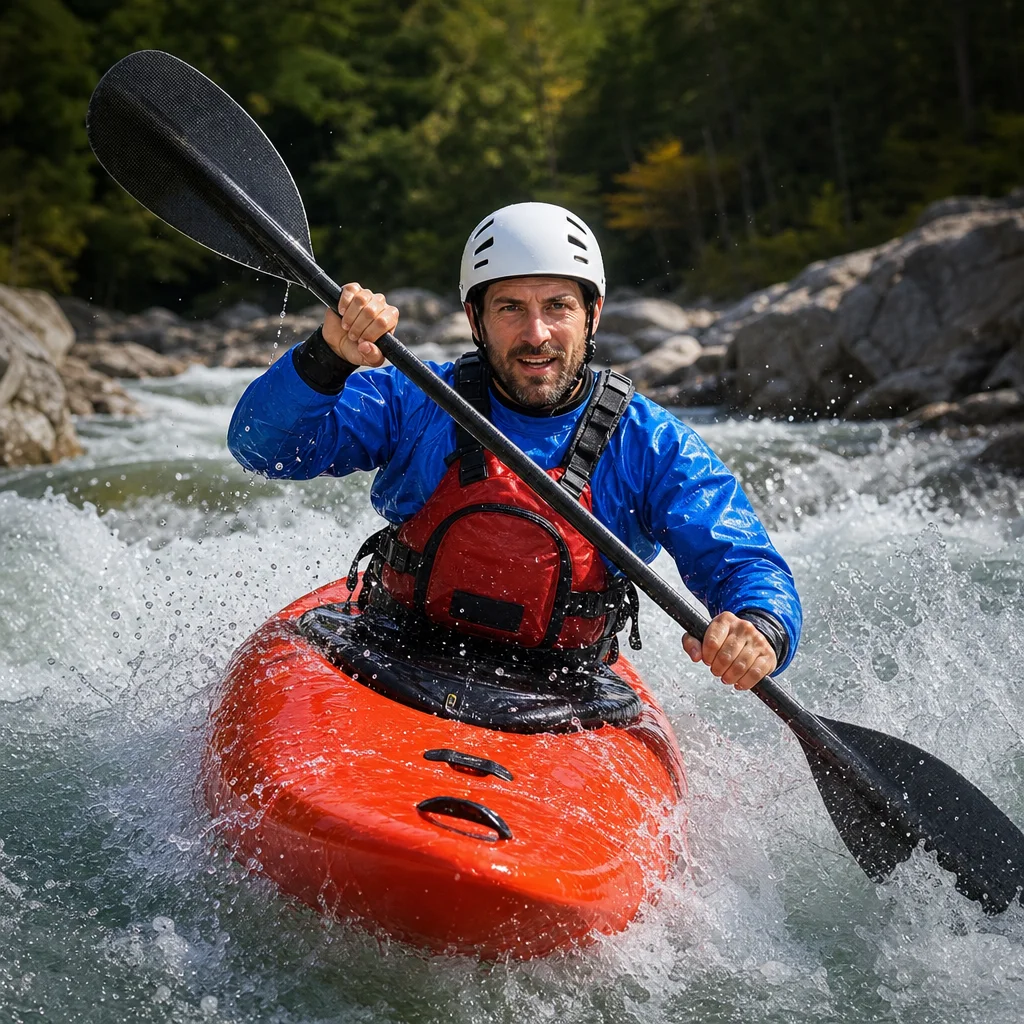
High water isn't a single number. A river may be above its usual level but relatively manageable in one reach, while a lower reading on a steep, narrow section can create powerful currents, dangerous hydraulics, and limited recovery options. Gauge height alone rarely tells you enough.
A safer decision combines several pieces of information: the gauge trend, discharge, current speed, river features, debris, launch and takeout conditions, weather, and your ability to handle the consequences of a mistake. The right question isn't simply, “Is the river high?” It is, “What will this water do in this specific section, and can I manage it if something goes wrong?”
Start with the right gauge information
Gauge height is a local measurement
A gauge reading describes water height at one location relative to that gauge’s reference point. It isn't a universal measure of river difficulty. A reading of 6 feet can be ordinary on one river and unusually high on another.
Use the gauge that best represents the section you plan to paddle, not merely the closest gauge by distance. A tributary, dam, diversion, or long stretch of river between the gauge and your launch can change conditions significantly.
Look for these details when reviewing a gauge:
- The gauge location and the river section it represents
- The river’s typical or seasonal range
- Historical high-water marks, when available
- Current discharge, usually shown in cubic feet per second (cfs)
- The direction and speed of the trend
- Any agency notes, warnings, or missing-data notices
Discharge often adds useful context
Discharge measures the volume of water moving past a point over time. It can help you understand how much water is in the river, but it still doesn't directly describe every hazard you will encounter.
Two sections can carry similar discharge while behaving very differently. A broad, gently sloped channel may spread the flow over a large area. A constricted channel may force that same water through a narrower passage, increasing current speed and the power of eddies, waves, and holes.
A rapidly rising gauge deserves extra caution even if the current number doesn't look extreme. Rising water can cover normally visible rocks, change eddies, flood channels, and move debris into the river. A falling gauge may reduce some hazards, but it can also leave new strainers, expose rocks, or create awkward shallow passages.
Check the current river picture: Before leaving, review the latest gauge height, discharge, trend, weather, flood statements, and local access information for your exact river section. Conditions can change between checking the data and reaching the launch.
Assess what high water changes on the river
Faster current reduces your reaction time
High water often means more current, but the main concern isn't just speed. Faster current gives you less time to recognize a problem, choose a line, and reach an eddy or bank.
A familiar stretch can become unfamiliar when the river rises. Current may run over banks, through vegetation, across normally calm side channels, or directly toward bridge supports and low-head dams. Small errors that are recoverable at ordinary levels can become serious when the current carries you quickly toward an obstruction.
Ask yourself:
- Can you identify the main current and likely hazards before entering it?
- Are there reliable eddies where you can stop or regroup?
- Can you ferry across the current without being pushed downstream too far?
- Is there enough open space to recover from a missed stroke?
- What happens if you swim at the fastest or most obstructed point?
If you can't answer these questions from current information, scouting, or reliable local knowledge, treat the uncertainty itself as a reason to wait.
Hazards may be hidden below the surface
High water can submerge rocks, fences, low branches, banks, and other obstacles. Flooded vegetation is especially concerning because a swimmer or kayak can become pinned against it. These hazards are often called strainers because water passes through while a person or boat may not.
Look for debris collected on the outside of bends, around bridge piers, at river-wide logjams, and along flooded banks. A single branch may be manageable; a broad mass of wood across moving water is a reason to avoid the entire area.
Don't assume that floating debris is the only danger. Submerged objects can create unpredictable boils and deflecting currents. Water moving over a normally obvious ledge or drop can form a hydraulic feature that is difficult to escape, particularly for a paddler who isn't practiced in reading and avoiding it.
Banks and access points can become hazards
The river may be more dangerous before you launch. High water can make a bank muddy, undercut, slippery, or unstable. A familiar beach may disappear, and a current that was once several yards away may now run beside the parking or unloading area.
Check whether you can safely carry the kayak to the water, enter without being swept downstream, and leave the river at the intended takeout. A takeout that is technically reachable may still be unsafe if the current presses against a steep bank or if there is no stable place to exit.
Consider the full route rather than only the moving water. A trip with no dependable exit points gives you fewer options if conditions worsen, someone becomes tired, or a boat is damaged.
Compare the river to your actual skills
Use consequence, not confidence, as the test
Confidence can be misleading on high water. You may have paddled the same river many times, but a changed flow can alter the difficulty, hazards, and consequences of a capsize.
A sensible decision considers whether you can:
- Maintain an active position in current
- Use forward, sweep, and braking strokes under pressure
- Turn toward and enter an eddy deliberately
- Ferry across current without losing control
- Avoid strainers, undercut banks, dams, and other known hazards
- Perform a reliable self-rescue or assisted rescue
- Keep your kayak, paddle, and body together after a swim
- Communicate with your group when conditions are loud or fast
For a beginner, high water is usually a poor setting for learning basic river control. Intermediate paddlers should still be cautious when the river introduces unfamiliar features, limited visibility, cold water, or long swims.
Match the boat to the conditions
A recreational kayak designed for calm water may be difficult to control in strong current. Long touring kayaks, inflatable boats, sit-on-top kayaks, and whitewater kayaks each respond differently to waves, turning demands, and recovery techniques.
Boat suitability doesn't replace skill. A boat that is appropriate for moving water can still become dangerous when paired with an inexperienced paddler, inadequate flotation, or a route beyond the paddler’s rescue ability.
Your personal equipment also matters. Wear a properly fitted personal flotation device, carry a suitable paddle, and dress for the water temperature rather than only the air temperature. Cold water can turn a short swim into an emergency quickly. Local laws and access rules may specify additional equipment or restrictions, so check the current requirements for the waterway.
Scout and gather local information
Data helps you estimate conditions; it can't show every obstacle. If possible, inspect the river from roads, bridges, or established access points before launching. Look for the direction of flow, debris, flooded banks, available eddies, and the location of safe exits.
Avoid standing close to unstable banks or walking onto private property to scout. A view from a bridge can also be misleading because it may show only one part of a rapid or omit hazards downstream.
Recent local reports can be valuable, especially after storms, floods, or major changes to a river channel. Ask experienced paddlers, outfitters, park staff, or land managers specific questions about the section and current conditions. “Is it safe?” is less useful than questions such as:
- Which hazards become worse at the current level?
- Are any strainers, bridges, dams, or portages newly problematic?
- Which launch and takeout points remain usable?
- Where are the reliable exits if the group turns around?
- Is the gauge representative of this section today?
Treat old trip reports and online comments as historical context, not a current clearance. A river can change after one storm or debris movement.
Recognize conditions that favor postponing
Postpone the trip when the river is rising quickly, official agencies have issued a warning relevant to your route, or you can't identify a safe launch and takeout. Also wait when debris is widespread, visibility is poor, weather is deteriorating, or the water temperature and rescue plan exceed your group’s preparation.
A planned route should have a clear turnaround point. If the first part of the trip feels faster, more obstructed, or less controllable than expected, don't continue simply because you have already launched. Turning back may be impossible once you pass a rapid, so make that decision early.
The strongest “no” is often based on several moderate concerns rather than one dramatic number: a rising gauge, muddy access, limited eddies, cold water, and a paddler who hasn't practiced rescues in current. Together, they can make a familiar route unsuitable.
A practical decision checklist
Before deciding that a river is suitable, confirm that:
- You have checked the correct gauge and understand its height, discharge, and trend.
- You know what the current conditions mean for the exact section you plan to paddle.
- You have checked weather, warnings, closures, and local rules from current official sources.
- You have considered debris, strainers, bridges, dams, flooded banks, and undercut hazards.
- The launch, takeout, and backup exits are usable and safe.
- Your kayak, equipment, and skills match the water’s speed and consequences.
- Everyone in the group understands the route, hazards, communication plan, and turnaround point.
- You have a realistic plan for a capsize, separation, injury, or worsening conditions.
If several answers are uncertain, choose a lower-consequence alternative: a sheltered section, a familiar lake, a guided outing, or another day. Waiting isn't a failure of judgment. It is one of the most effective ways to keep a high-water decision from becoming a rescue problem.