How to Set a Meeting Point When a Kayak Group Splits Up
I’ll show you how to prevent a split kayak group from turning into a search problem by choosing a visible meeting point, setting a clear time limit, and agreeing on communication and regrouping decisions before anyone separates.
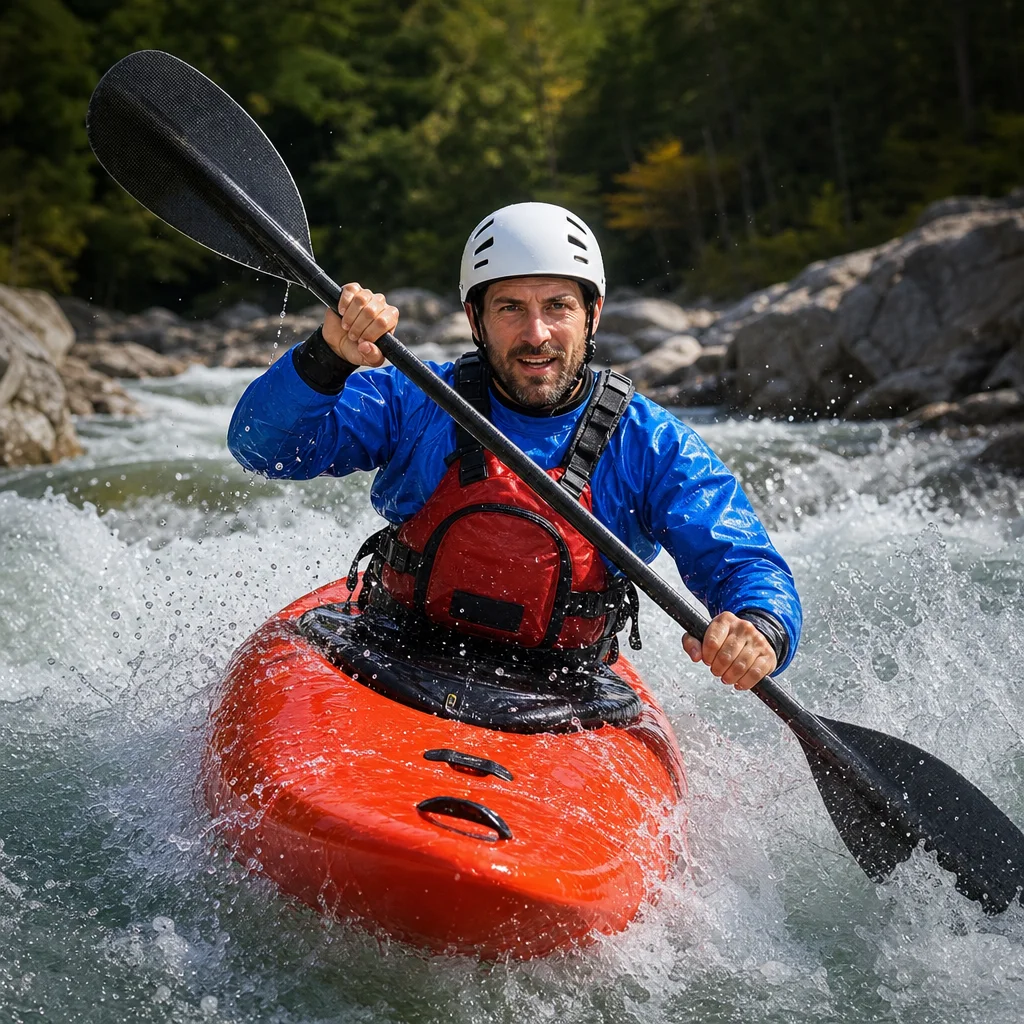
When a kayak group separates, the biggest mistake is assuming everyone will independently choose the same place to wait. One paddler may stop at the next beach, another may continue to a launch, and a third may turn back toward the last known location. A meeting point only works when the entire group understands exactly where it is, when to go there, and what to do if the plan fails.
A simple regrouping procedure should answer four questions:
- Where will we meet?
- When will we meet there?
- How will we communicate if plans change?
- What will we do if someone doesn’t arrive?
You can establish those answers in a minute or two before the group splits. That small pause is usually easier than trying to coordinate several kayaks from opposite sides of a bend, island, or busy shoreline.
Decide whether the group should split at all
A split may make sense when paddlers have different speeds, destinations, or comfort levels. It may also be necessary if weather, fatigue, or an equipment problem makes continuing together impractical. But separation adds uncertainty, especially when visibility is poor or the route has several possible channels and landing areas.
Before agreeing to separate, consider whether the slowest or least experienced paddler can safely continue alone or with a smaller subgroup. A beginner shouldn't be left to navigate an unfamiliar area without a capable partner simply because the rest of the group is eager to move on.
Keep the group together when:
- Conditions are deteriorating or difficult to interpret.
- The route has strong current, surf, heavy boat traffic, or limited landing options.
- A paddler is cold, injured, exhausted, or having trouble controlling the kayak.
- The group lacks a reliable way to communicate.
- Several people are unfamiliar with the route.
- You can't identify a meeting point that everyone can recognize.
If the split is necessary, make it a deliberate decision rather than a gradual drift. Stop in a safe location, gather attention, and state the plan where everyone can hear it.
Choose a meeting point that is hard to confuse
A good meeting point is visible from the water, accessible to the whole group, and suitable for waiting. “The next beach” or “the other side of the island” may sound clear in conversation but can be ambiguous on a shoreline with several beaches, coves, or channels.
Look for a location with several identifying features:
- A prominent point, bridge, marina entrance, large dock, or distinctive bluff.
- A safe landing area with enough room for the expected kayaks.
- Clear visibility from the approach direction.
- Protection from wind, waves, current, and boat traffic.
- A position that can be identified on a chart or navigation app.
- More than one way to recognize it, such as “the sandy beach immediately east of the red-roofed building.”
Avoid choosing a meeting point solely because it is the closest visible shoreline. A narrow beach exposed to waves may be a poor waiting area, and a point hidden behind an island may be impossible to see from the wrong approach.
If the group is traveling along a long shoreline, choose a primary point and a backup point. The backup should be farther along the planned route or at another clearly identifiable location, not an improvised option that only one subgroup knows about.
State the plan in a repeatable format
Use the same short format every time. This reduces misunderstandings when the group is tired, cold, or distracted by changing conditions.
A useful briefing sounds like this:
“The primary meeting point is the public beach on the north side of Cedar Island, beside the tall white sign. We’ll meet there at 2:30 p.m. If you arrive first, stay with your kayak and wait until 2:45. If we’re not all there by then, call or text the group. If communication fails, the backup point is the launch ramp at the west end of the island. Nobody continues past the backup without confirming the plan.”
Adjust the details to fit the route, but make sure the briefing includes:
- The exact meeting point.
- A landmark visible from the water.
- The planned arrival time.
- The latest time anyone should wait there.
- The backup meeting point or fallback action.
- The communication method.
- Who is responsible for confirming that everyone is accounted for.
Ask one or two paddlers to repeat the plan back. This isn't an exam; it is a quick way to catch errors such as confusing east and west or mixing up the primary and backup locations.
Use time limits instead of open-ended waiting
“Wait for us there” is incomplete. Without a time limit, one subgroup may leave just as another arrives, creating a second split.
Set three separate times when the route calls for it:
Planned arrival time
This is when the group expects to reach the meeting point. It gives everyone a shared target without requiring perfect timing.
Latest waiting time
This is the point at which the group changes its plan. The length depends on conditions, daylight, distance, temperature, and the experience of the paddlers. A short wait may be appropriate on a cold, exposed shoreline; a longer wait may be reasonable at a protected launch with good communication.
Escalation time
If someone is still missing after the latest waiting time and communication has failed, identify who will take the next action. That could mean returning along the planned route, moving to a backup point, contacting a responsible person on shore, or seeking emergency assistance if there is a genuine safety concern.
Don't use a time limit as permission to abandon someone who may be in danger. If a paddler is overdue, injured, separated from their kayak, or expected to be traveling through hazardous conditions, treat the situation as a safety problem rather than a scheduling inconvenience.
Agree on communication before you separate
Tell the group exactly how to make contact. “We’ll message each other” isn't enough if some paddlers have no signal, their phones are stored out of reach, or everyone is using different apps.
Choose a primary method and a backup. Depending on the trip, options may include:
- Phone call or text message.
- Marine or handheld radio, when the group knows how to use it.
- Whistle or other agreed audible signal for short-range contact.
- Visual signals between nearby kayaks.
- A shore-based contact who knows the route and the expected return time.
Keep phones and communication devices protected from water but accessible enough to use. Test the method before the split, particularly in areas where cellular coverage may vary by shoreline, valley, or island.
If you use a radio, agree on the channel and call signs or simple identifiers. If you use phones, exchange numbers rather than assuming everyone belongs to the same group chat. Make sure at least one person in each subgroup knows the complete route and the meeting procedure.
Verify the route before launching: Check current weather, wind, water temperature, tide or river-flow conditions where relevant, local closures, launch rules, and communication coverage for the specific area. Conditions and access restrictions can change, so use current information rather than relying only on an old map or a previous trip.
Give each subgroup a clear responsibility
A group split works better when each subgroup knows who is making decisions. Identify a lead paddler and a sweep paddler for each subgroup, even if the separation is brief.
The lead should know the route to the meeting point and avoid making an unplanned detour. The sweep should confirm that the intended paddlers have left together and that nobody is falling behind. If one subgroup contains newer paddlers, place an experienced person with them rather than leaving them to navigate independently.
The trip leader should also know the composition of each subgroup. A simple count is useful:
- Subgroup A: three paddlers, including the leader.
- Subgroup B: four paddlers, including the sweep.
- One paddler with a towline, first-aid kit, or other shared item.
This prevents a common error: knowing that “the group” has reached the meeting point without knowing whether every person and kayak is present.
Build a conservative fallback plan
The safest fallback is usually the simplest one. If the primary meeting point is inaccessible, don't improvise several new locations. Use a preselected backup or return to the last confirmed safe location, depending on the route and conditions.
Your fallback should account for situations such as:
- The beach is occupied, closed, or unsafe to land on.
- Wind or current prevents a subgroup from reaching it.
- The landmark is obscured by fog, darkness, or heavy rain.
- A phone battery has failed or coverage is unavailable.
- One subgroup arrives early and leaves before the other arrives.
- A paddler becomes tired or develops a minor equipment problem.
Set a rule against continuing farther simply to “look for” another subgroup unless the conditions, route, and group capability make that safe. Searching by kayak can create another separation and may take rescuers farther from the last known location. If the group can't account for someone and there is a credible risk to their safety, use the appropriate emergency or local assistance channel rather than extending an uncoordinated search.
Record the plan where you can find it
A verbal plan can disappear quickly once paddlers are moving. Put the essentials in a phone note, waterproof notebook, chart annotation, or shared message before launching:
- Primary meeting point and landmark.
- Backup point.
- Planned arrival and latest waiting times.
- Subgroup members.
- Communication method.
- Shore contact, if one is being used.
- Launch location and planned takeout.
Use plain language and include coordinates only as a supplement to recognizable landmarks. Coordinates can be entered incorrectly, displayed in the wrong format, or difficult to interpret while handling a kayak. A landmark plus a chart position is more useful than either one alone.
A quick procedure for the moment of separation
When the group is about to split, follow this sequence:
- Stop in a safe location and gather everyone’s attention.
- Confirm why the group is separating and whether anyone needs assistance.
- Name the primary meeting point and describe at least two identifying features.
- State the planned arrival time and latest waiting time.
- Name the backup point and the rule for using it.
- Confirm the communication method and test it if practical.
- Assign a lead and sweep for each subgroup.
- Count paddlers and note any shared equipment.
- Ask someone to repeat the plan.
- Reassess the plan if wind, current, visibility, or fatigue changes.
This procedure is intentionally short. A complicated plan may look thorough but be difficult to remember under pressure.
Common mistakes to prevent
Choosing a landmark that can’t be seen from the water
A building hidden behind trees or a sign visible only from land may not help an approaching paddler. Favor landmarks with a clear water-side view.
Using relative directions without a reference
“East side” can be confusing when people approach from different directions or when the route bends. Pair directional language with a landmark and a chart or map reference.
Setting a meeting point but no departure rule
Everyone may wait, leave, and circle back at different times. State when the plan changes and who makes that decision.
Assuming phone service will work
Treat communication coverage as a useful possibility, not the foundation of the entire plan. Carry a backup method appropriate to the area and group.
Letting the fastest paddlers choose the schedule
A meeting time should reflect the slowest reasonable subgroup, not the pace of the strongest paddler. Add margin for wind, current, navigation, and short breaks.
Moving the meeting point without confirmation
An unannounced change creates uncertainty. If the original point is unsafe or unreachable, use the agreed backup and communicate the change whenever possible.
Practical next steps
Before your next group outing, choose a route with a primary and backup meeting point. Save both locations, decide on a realistic arrival and latest waiting time, and send the procedure to every paddler. At the launch, confirm the plan aloud and make sure each subgroup has a leader, a sweep, a communication method, and a way to recognize the landmark.
The goal isn't to prevent every separation. It is to make a separation predictable, visible, and reversible before it becomes a problem.