How to Use a Greenland-Style Paddle for Recreational Kayaking
I’ll help you decide whether a Greenland-style paddle fits your recreational kayaking, then explain how to size your grip, refine your stroke mechanics, choose a useful cadence, and weigh efficiency against power and versatility.
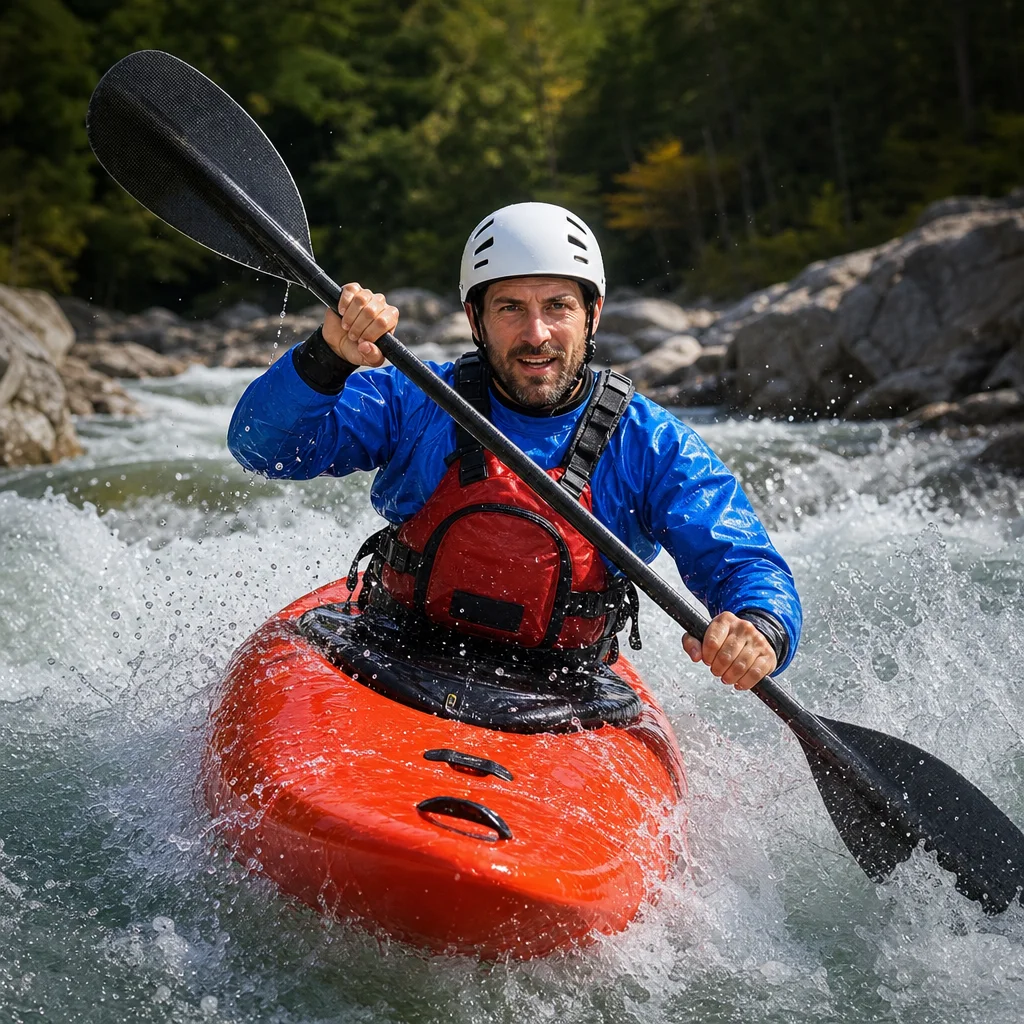
A Greenland-style paddle can look too narrow to deliver useful power, especially if you’re accustomed to a wide-bladed Euro-style paddle. Its advantages become clearer when you stop trying to copy the same stroke: the long, slim blades reward smooth loading, relaxed grip, and steady cadence rather than short bursts of force.
For recreational touring, that can mean less hand fatigue, efficient cruising, and one simple paddle that works across a wide range of conditions. It also comes with trade-offs. You may give up some acceleration, braking force, and immediate leverage while learning the technique.
Understand the Greenland paddle’s design
A traditional Greenland-style paddle has long, narrow blades connected by a relatively short loom, or center grip. The blades usually taper toward the tips and have little or no pronounced spoon shape. Many modern versions use wood, fiberglass, or carbon, but the basic geometry remains similar.
The paddle’s narrow profile spreads the work over a longer blade. Instead of catching a large surface area all at once, you progressively load the blade as it enters the water. That smooth loading is central to the paddle’s comfortable feel.
The loom is usually held with both hands near the center rather than at the wide, marked hand positions common on many Euro paddles. Because the blade faces are often symmetrical, you can rotate the paddle naturally in your hands without relying on a fixed feather angle.
This simplicity can be a resource advantage. A well-made Greenland paddle has few moving parts, doesn't require an adjustable ferrule, and can serve for touring, skill practice, and low-angle cruising. A single paddle may cover more of your ordinary paddling than a collection of specialized options.
Set your grip before you worry about power
Place your hands on the loom at roughly shoulder width. Your elbows should remain slightly bent, and your shoulders should stay relaxed. Avoid gripping the paddle tightly enough to whiten your knuckles or lock your wrists.
A useful test is to hold the paddle in front of you and make small rotations with your wrists and forearms. The paddle should feel controlled without forcing your elbows outward. If your hands are too close together, the paddle may feel unstable and underpowered. If they are too far apart, you’ll create unnecessary shoulder strain and reduce the paddle’s comfortable range of motion.
Keep the thumb and fingers secure but light. Your lower hand helps guide the working blade, while the upper hand provides direction and modest pressure. You don't need to squeeze the shaft throughout the stroke.
With a symmetrical Greenland paddle, blade orientation comes from how you rotate the shaft. Let the paddle roll naturally between your fingers as needed rather than trying to maintain a rigid feather angle. This can feel unfamiliar if you’ve spent years using a Euro paddle with a fixed orientation.
Check the paddle’s balance
Support the paddle near its center and notice whether one side drops sharply. A balanced paddle makes repeated transitions easier and reduces the effort needed to reposition the blades.
Balance varies with material, blade thickness, and loom shape. A heavier paddle isn't automatically inefficient, but extra weight at the blade ends can make a high-cadence stroke tiring. For everyday touring, a paddle that feels predictable through the recovery is often more valuable than one that simply has the lowest listed weight.
Use a smooth catch and a connected stroke
Begin with the blade close to the kayak and enter the water near your toes. Keep the blade relatively vertical during the catch, then let it travel alongside the hull toward your hip. Exit around your hip rather than reaching far behind you.
The key movement comes from torso rotation, not just arm pulling. Wind your torso slightly as the blade enters, then rotate back toward the opposite side as the blade moves through the water. Your legs can help anchor the movement against the foot braces, but your upper body should remain relaxed.
Think of the stroke as loading the blade gradually:
- Rotate your torso and place the blade quietly in the water.
- Engage the blade by moving your body, not by yanking with your lower arm.
- Keep the blade close to the kayak so the force supports forward travel.
- Finish near your hip.
- Lift the blade out and allow it to recover smoothly.
A Greenland paddle often feels best when the blade is slightly canted. The leading edge enters cleanly while the blade’s surface maintains a useful grip on the water. The exact angle depends on your paddle shape and technique, so begin with a shallow, controlled angle and adjust gradually.
If the paddle slips out of the water, ventilates, or makes a loud splash, reduce your force and slow the stroke. Noise isn't a perfect measure of efficiency, but a quiet catch and clean exit usually indicate that you’re controlling the blade rather than overpowering it.
Find a cadence that matches the paddle
A narrow blade generally works well with a steady cadence. Rather than taking a few powerful strokes and coasting, use shorter, repeatable strokes that keep the kayak moving consistently.
For relaxed touring, begin at a pace that lets you breathe comfortably and maintain torso rotation. Your stroke should feel almost modest at first. Gradually increase cadence while keeping the catch, exit, and recovery clean. If your shoulders tense or your hands begin to clamp down, you’ve probably increased effort faster than your technique can support.
A higher cadence can help maintain speed without demanding a heavy catch on every stroke. It also makes small course corrections easier because you have frequent opportunities to adjust. The trade-off is that a rapid cadence can become tiring if your paddle is too long, too heavy, or poorly balanced.
Use a lower cadence when maneuvering slowly, looking around, or paddling through cluttered water. Use a quicker cadence when accelerating from a stop or maintaining speed into a light headwind. You don't need to treat cadence as a fixed number; match it to the conditions and the effort you want to sustain.
Check your setup before a longer outing: In calm, familiar water, confirm that you can maintain relaxed shoulders, a clean catch, and a comfortable cadence for several minutes. Recheck local conditions, required equipment, and launch restrictions before paddling somewhere unfamiliar, since those details can vary by location and change over time.
Adapt common strokes to the Greenland paddle
You can use familiar strokes, but make them less forceful and more connected to your torso.
Forward stroke
Keep the working blade close to the kayak and exit around your hip. A long reach behind you increases turning force and can place stress on your shoulder without adding much useful drive.
Reverse stroke
Place the blade near your hip and move it forward along the hull. Keep the motion compact. A Greenland paddle’s narrow blade can provide effective stopping and reverse movement when you keep the blade engaged rather than snapping it through the water.
Sweep stroke
Use a broad arc away from the kayak, but avoid trying to sweep with only your arms. Rotate your torso and allow the blade to travel through the water at a controlled depth. A longer blade can create useful leverage, so moderate force is usually enough.
Draw stroke
Reach out only as far as you can without leaning excessively. Place the blade in the water and draw it toward the kayak with your torso and lower body supporting the movement. Keep the blade from striking the hull at the end of the draw.
Sculling and bracing
The thin blade can be effective for subtle sculling movements and low-angle support, but it may not feel as immediately powerful as a wide Euro blade during a hurried brace. Practice support strokes in calm, shallow conditions with appropriate safety equipment before depending on them in rougher water.
Weigh the practical trade-offs
A Greenland paddle can be a cost-efficient choice when you value simplicity, comfort, and regular touring more than maximum acceleration. It may reduce the need for multiple paddles and can be relatively straightforward to maintain, particularly in a fixed-shaft design.
Its limitations matter too. A narrow blade may feel slow when you need to accelerate a heavily loaded kayak, punch through strong wind, or make repeated high-power maneuvers. Some paddlers also need time to adjust to the longer blade, closer hand spacing, and rolling orientation.
A Euro paddle may remain the better tool if you frequently sprint, paddle whitewater, carry heavy loads, or want strong, immediate braking and acceleration. You can also keep both styles and use the Greenland paddle for relaxed touring while reserving the Euro paddle for situations that demand more peak power.
Sizing affects the decision. A paddle that is too long can make the stroke awkward and increase recovery effort; one that is too short may force you to reach or bury less blade than intended. Manufacturer recommendations are useful starting points, but your kayak width, torso height, stroke style, and typical conditions all matter. If possible, test a few lengths on the water instead of choosing by length alone.
Build skill without wasting effort
Start in calm water and paddle at an easy pace. Focus on three things: a quiet catch, a relaxed grip, and an exit near the hip. Once those feel consistent, add short periods of faster cadence and practice stopping, reversing, sweeping, and drawing.
Record how your shoulders and forearms feel after a normal outing. Persistent shoulder pain, numbness, or wrist discomfort is a reason to stop and reassess your grip, paddle length, torso rotation, and seat position. More force is rarely the best correction.
Before buying another paddle, ask what problem you’re actually trying to solve. If you need less fatigue and a dependable cruising tool, a Greenland-style paddle may fill that role efficiently. If you need sharper acceleration or stronger support strokes, its lower peak power may be a meaningful limitation.
The most economical choice is the paddle that matches your usual water and keeps your technique sustainable. Try the Greenland style gradually, refine the catch and cadence, and judge it by how comfortably it supports your real trips—not by how narrow the blades look on the dock.