Reverse Paddling: The Simplest Way to Back Away From Trouble
I’ll explain how to use a controlled reverse stroke to move away from a crowded launch, stop an awkward approach, and avoid nearby obstacles without relying on last-second scrambling. You’ll learn the basic motion, steering corrections, and edge cases that make backing up predictable.
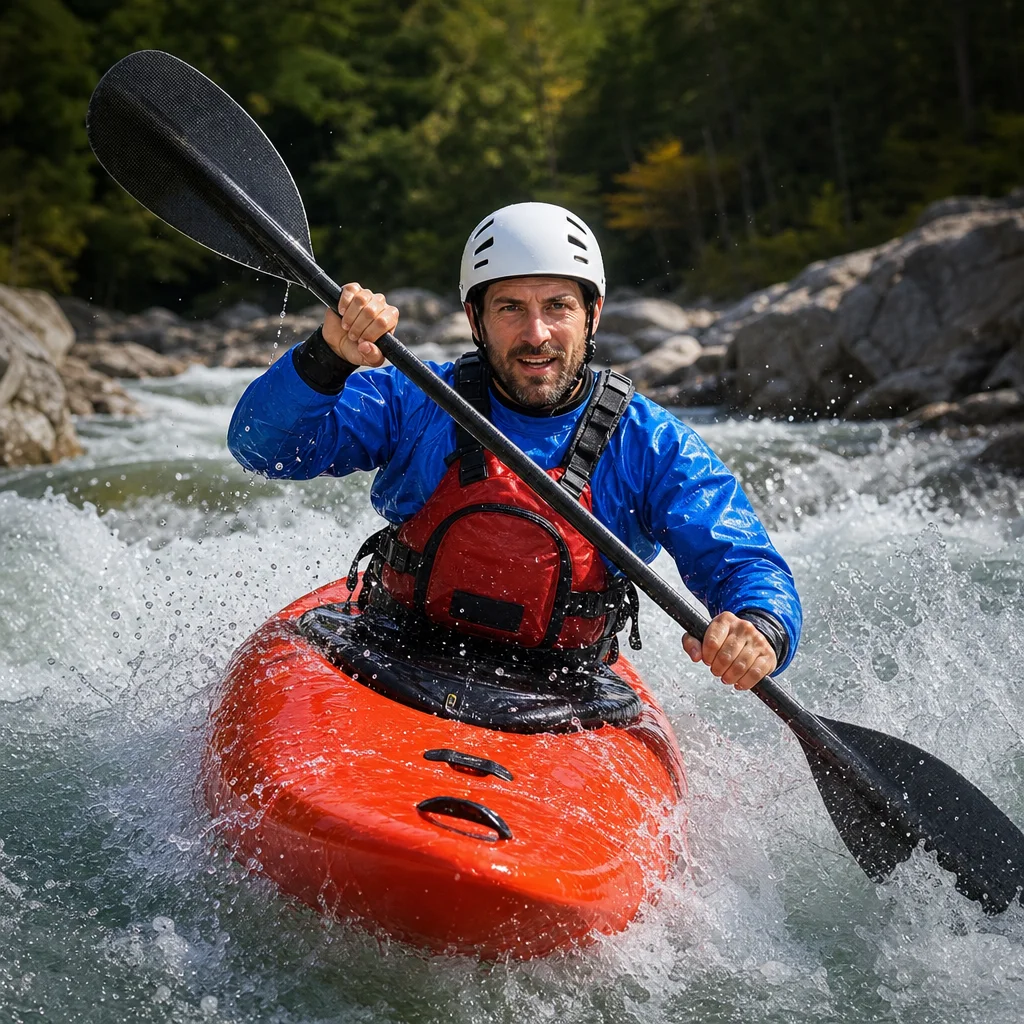
When a launch area gets crowded or your kayak starts drifting toward a dock, another boat, or a shallow bank, turning around may not be the best first move. A controlled reverse stroke lets you create space while keeping your eyes on the problem in front of you.
The stroke is simple: place the blade near your hip, push water toward the bow, and recover near your feet. Repeat on alternating sides to move backward. The challenge is making the movement deliberate enough to steer, stop, and avoid overcorrecting.
What the reverse stroke does
A reverse stroke moves your kayak backward by pushing water forward. It also affects your direction because each stroke creates more force on one side than the other.
- A reverse stroke on the left tends to move the stern toward the right and the bow toward the left.
- A reverse stroke on the right tends to move the stern toward the left and the bow toward the right.
The exact response depends on your kayak’s shape, your stroke angle, wind, current, and how much force you use. Think of those directional effects as useful tendencies rather than fixed rules. Start gently and watch how your boat responds.
The reverse stroke is most useful when you need to:
- Back away from a crowded launch or dock
- Create space from another kayak
- Correct an approach that is becoming too close or awkward
- Move away from a rock, log, or shallow shoreline
- Adjust your position before turning or paddling forward
It isn't a substitute for looking around. Before backing up, check behind you as well as to both sides. You may have more blind space behind the kayak than you expect.
The basic reverse stroke, step by step
1. Set a stable position
Sit upright with your shoulders relaxed and your feet supported by the footrests. Keep the paddle shaft in front of your body and your hands in a normal paddling position.
Avoid leaning far backward to reach behind you. That reduces your balance and usually makes the stroke weaker. Your torso rotation should create the reach, not a sudden bend through your lower back.
2. Look where you intend to go
Turn your head and upper body to check the space behind you. If you can, look over one shoulder and then the other. A quick glance is better than trying to paddle entirely by feel.
Once you begin moving, keep scanning. Your kayak may travel farther than expected after the first stroke, especially on calm water where there is little resistance.
3. Place the blade near your hip
Rotate your torso and reach one blade back along the side of the kayak. Place the blade in the water around your hip or slightly behind it, with the blade fully submerged before applying pressure.
Your lower hand should stay fairly relaxed. Avoid dropping your top hand dramatically, which can bury the blade at an awkward angle and make the kayak wobble.
4. Push water toward the bow
Press forward with the submerged blade. As the blade moves from your hip toward your feet, rotate your torso back toward the front of the kayak.
The stroke should feel like a controlled push rather than a hard pull. Keep the blade close to the kayak. A blade that swings far away from the hull creates more turning force and less clean backward movement.
5. Recover near your feet
When the blade reaches your feet, lift it clear of the water and rotate to set up the opposite side. Don't continue forcing the blade past your feet. A long, deep finish can catch the water and turn the kayak more than you intended.
Repeat on the other side. Use short strokes at first, then increase their length only when the kayak is tracking in the direction you want.
How to back away in a straight line
Straight reverse paddling comes from keeping the strokes balanced. Use similar stroke length and pressure on both sides, and pause briefly if you need to check your position.
For a beginner, the most reliable sequence is:
- Look behind you and choose a clear path.
- Take a short reverse stroke on one side.
- Take a similar stroke on the other side.
- Pause and check your position.
- Repeat only as much as needed.
Small strokes are easier to control than powerful ones. If the kayak begins to veer, don't immediately use maximum force on the opposite side. First, reduce the length of the next stroke. Then add a gentle corrective stroke on the side that brings the bow back toward your intended line.
Your paddle can also act as a brief brace while you pause, but it shouldn't be used as a substitute for balance or awareness. Keep your movements smooth, especially near docks and other boats.
Check your escape space: Before reversing from a launch, dock, or shoreline, confirm that the area behind you is clear of people, boats, submerged objects, and moving water. If you can't see well, use shorter strokes and reposition before committing to more distance.
Steering while moving backward
A reverse stroke does two things at once: it moves the kayak backward and changes its heading. That can be helpful when you need to back away at an angle.
Suppose the bow is pointed too close to an obstacle on your left. A gentle reverse stroke on the left may help move the bow away from that side, but the result varies by kayak and stroke position. Begin with one light stroke, observe the bow, and adjust rather than assuming the correction will be exact.
You can also use a reverse sweep to turn more deliberately. Instead of keeping the blade close to the hull, make a wider arc from near the hip toward the bow. This creates more turning force and less direct backward travel. Use it only when you have enough room, because a wide blade path can bring the kayak’s bow or stern closer to something nearby.
For tight spaces, alternating short reverse strokes are usually easier to manage than a large sweep. Think of each stroke as a small steering decision.
Common situations and the best response
Leaving a crowded launch
A launch may have kayaks pointing in several directions, people standing in shallow water, and paddlers preparing to move forward. If your bow is pointed into traffic, don't force a turn immediately.
First, take one or two short reverse strokes to create space. Keep the paddle low and your movements compact. Once you have room, use a controlled forward or reverse sweep to set your heading, then move away at a steady pace.
If someone is launching behind you, communicate clearly before moving. A simple warning that you are backing up gives nearby paddlers a chance to pause.
Correcting an approach to a dock
If you are drifting toward a dock faster than expected, use a reverse stroke on the side that helps move the bow away while continuing to watch the dock. If you are already very close, a firm but controlled reverse stroke on both sides may be better than trying to make a large turn.
Keep your hands and paddle away from gaps, cleats, and other snag points. If contact is unavoidable, stay calm and avoid reaching far outside the kayak to fend off the dock. A sudden reach can make you less stable.
Avoiding a floating obstacle
When a log or other object is directly ahead, a reverse stroke can create distance while you decide whether to turn. Don't wait until the kayak touches the obstacle. Water movement, wind, and momentum can make the final distance disappear quickly.
If the obstacle is to one side, use a small corrective stroke rather than a dramatic sweep. Once clear, return to balanced reverse strokes or turn away when you have enough room.
Backing out of shallow water
A kayak may slow as the bottom becomes shallow, and the paddle may strike the bottom instead of pushing cleanly against the water. Use shorter strokes and avoid driving the blade into the substrate.
If the kayak is grounded, pulling harder on the paddle can damage the blade or make you lose balance. Shift your weight carefully, use your hands only where the bottom is stable and safe to reach, or exit according to the conditions and your training.
Mistakes that make reverse paddling harder
Looking only over one shoulder
A single glance leaves part of your path unchecked. Scan both sides before moving and continue checking as you reverse.
Taking strokes that are too long
A blade that travels far past your feet is harder to control and can turn the kayak sharply. Keep the working part of the stroke between the hip and feet.
Using only your arms
Arm-dominated strokes tire quickly and often produce uneven pressure. Rotate your torso while keeping your grip relaxed. Your arms guide the paddle; your torso provides much of the controlled movement.
Paddling too hard near obstacles
Power isn't the same as control. Near a dock, person, or rock, a short stroke with a clear purpose is usually more useful than a forceful stroke that changes your heading unexpectedly.
Forgetting momentum
The kayak may continue moving after you stop paddling. Begin slowing or changing direction before you reach the point where you want the movement to end.
Practice the stroke safely
Practice in open, calm water with plenty of room around you. Start by reversing two or three boat lengths, then stop and check how straight you traveled. Repeat using shorter strokes, then try gentle corrections to each side.
Next, place a visible reference point at a comfortable distance and practice backing toward it without reaching it. Stop well before the reference point. This teaches you to judge momentum instead of waiting until the kayak is already too close.
You can then practice a simple sequence: reverse, correct your heading, stop, and move forward. The goal isn't speed. You are learning how much the kayak responds to one stroke and how much space you need for a correction.
Practical next steps
On your next outing, spend a few minutes practicing reverse strokes before you need them. Remember three priorities:
- Look behind you and keep scanning.
- Use short, balanced strokes near obstacles.
- Make one small correction at a time.
Once the motion feels familiar, practice backing away at an angle and stopping with room to spare. A reliable reverse stroke gives you another option when turning is inconvenient—and a calm option is often the most useful one in a crowded or restricted space.